
- By Admin
-
 Advertising
-
 04 June, 2026
Running a successful Amazon business isn't just about driving order volume. If you’re building an e-commerce brand today, you likely spend hours every week staring at Seller Central, trying to answer fundamental questions about your daily operations—questions that directly impact your net profitability, marketplace ratings, and scaling strategy.
The real frustration? The data exists. But it’s buried under a mountain of scattered Amazon reports, siloed dashboards, and confusing MTR (Merchant Tax Report) or settlement sheets.
If you find yourself chasing your tail on these three critical operational questions every single week, you are definitely not alone.
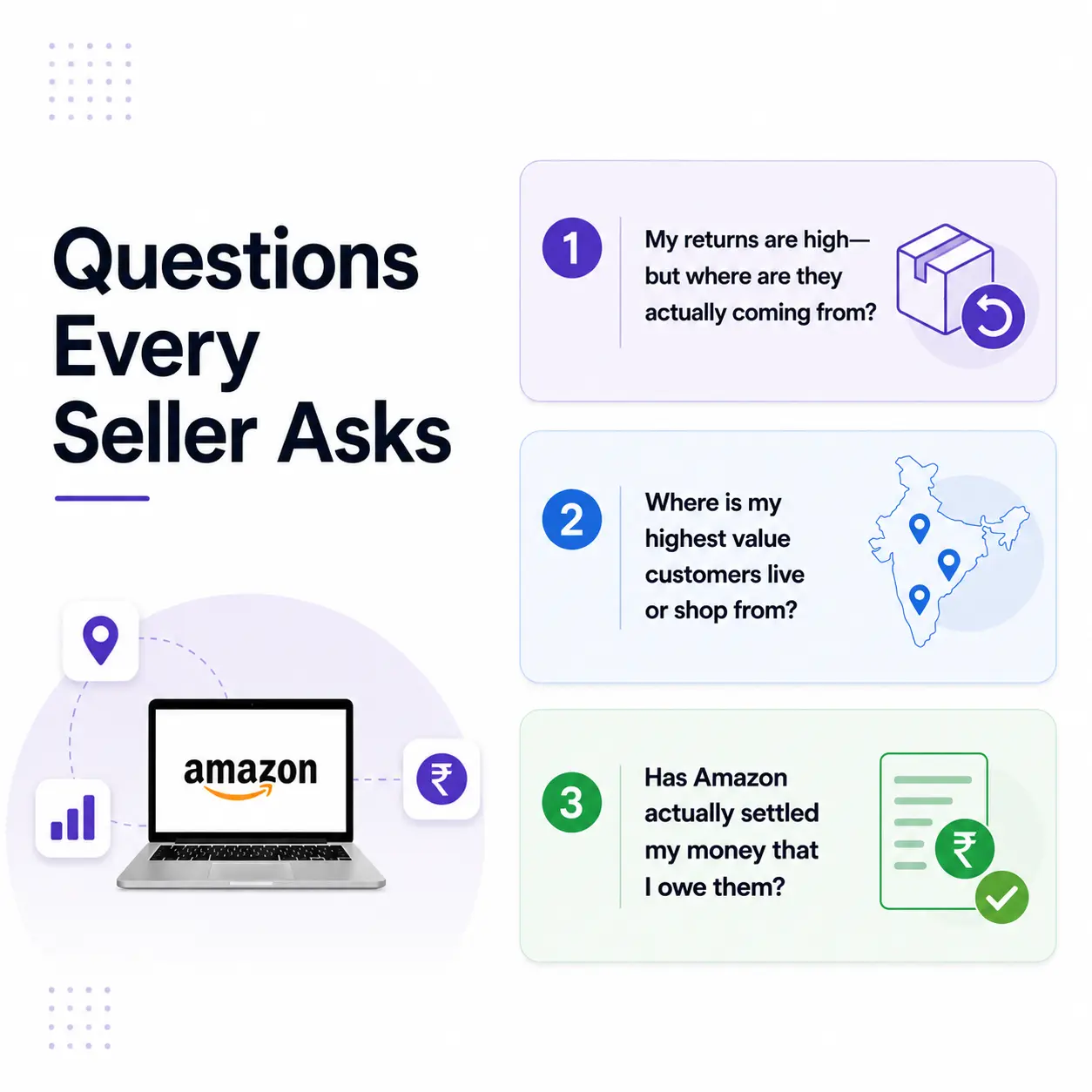
1. My returns are high—but where are they actually coming from?
When your return rate spikes on Amazon, the gut reaction is usually a wave of
panic:
Is there a sudden quality issue with this batch?
Are customers misinterpreting the product's images?
But there’s a massive blind spot most sellers miss “granular geography and RTO (Return to Origin) dynamics.”
Without drilling deep into your inventory and customer reports, you won't know:
- Which specific PIN codes or cities are generating the highest volume of returns.
- If a localized logistics or courier partner issue is causing transit damage in a specific state.
- Whether you are being targeted by localized return abuse or high wallet-fraud zones.
Imagine realizing that 40% of your product returns are concentrated in just a small handful of pin codes or are heavily tied to specific regional COD orders. Suddenly, it’s not a product defect issue—it’s a regional logistics or targeting problem. Having that location intelligence completely changes how you optimize your ad targeting and saves your margins from being eaten up by reverse logistics costs.
How eComSuite Helps
With eComSuite's Return Analytics, sellers can visualize exactly where their returns are coming from.
Instead of looking at a total return count, you can:
- Identify return-heavy cities and states
- Analyze return trends by region
- Compare sales vs returns geographically
- Spot potential operational or logistics issues early
This helps sellers move beyond "returns are increasing" to understand why they are increasing and where action is needed.
2. Where is my highest value customers live or shop from?
As an Amazon seller, you naturally obsess over ACoS (Advertising Cost of Sales), keyword bidding, and winning the Buy Box. But it’s incredibly easy to overlook customer geography.
In a diverse market of Amazon, knowing exactly where your geographic demand is concentrated is a goldmine for operational efficiency. It allows you to:
- Optimize FBM Inventory Placement: If most of your orders comes from southern tech hubs like Bengaluru, Hyderabad, and Chennai, or high-volume metro zones like Mumbai and Delhi-NCR, you need your stock positioned in fulfillment centers closest to those zones.
- Slash Delivery Timelines: Proximity means moving your products from "ordered" to "delivered" in 24-48 hours, making you hyper-competitive for those coveted "Prime Next-Day" badges.
- Smart Regional Ad Spend: Instead of burning ad budgets uniformly across the country, you can allocate your external marketing spend like Meta or Google Ads driving to your Amazon store towards states with proven, high-converting customer bases.
Turning raw location data into actionable supply chain decisions is what separates kitchen-table brands from lean, high-growth D2C powerhouses.
How eComSuite Helps
eComSuite's Customer Geo Mapping provides a clear view of your customer distribution.
You can quickly identify:
- Regions generating the highest sales
- Emerging demand pockets
- Geographic sales concentration
- Opportunities to improve fulfillment and delivery planning
These insights help sellers make informed decisions around inventory placement, warehouse expansion, and regional growth strategies.
3. Has Amazon actually settled every single Rupee that I owe them?
This is the ultimate weekly headache for every seller. Tracking your actual bank payouts against Amazon’s complex fee deductions feels like trying to hit a moving target.
Every single settlement cycle involves a tedious process of:
- Gross sales payments and buyer refunds
- FBA weight-handling and storage fees
- Easy Ship charges or self-ship logistics costs
- Closing fees, referral fees, and promotional rebates
As your order volume scales, manually reconciling every single transaction using Excel sheets becomes practically impossible.
You’re left wondering:
- Did I get reimbursed for that customer’s return that never made it back to the warehouse?
- Are there pending adjustments slipping through the cracks?
- Is my cash flow actually healthy after accounting for GST?
identifying discrepancies is a nightmare. Unreconciled transactions can quietly sit in Seller Central for months, costing your business lakhs in unclaimed FBA reimbursements.
How eComSuite Helps
eComSuite's Settlement & Reconciliation module automatically matches orders, settlements, refunds, fees, and adjustments.
Instead of manually reviewing reports and spreadsheets, sellers can:
- Track unsettled transactions
- Identify reconciliation discrepancies
- Verify settlement accuracy
- Gain greater visibility into cash flow
This reduces manual effort and helps ensure that every transaction is accounted for with confidence.
The Bottom Line: Moving From Data to Action
The modern Amazon challenge is not a lack of data; it's data fatigue.
Answering foundational operational questions should not require five open spreadsheets and hours of manual data sorting. The faster you can extract clear insights from the noise of Seller Central, the faster you can plug profit leaks and protect your margins.
Because sustainable, profitable growth isn't just about chasing the next order. It’s about mastering the operational reality happening behind the scenes of those orders
Please check this and now you can add how ecomsuite is solving each of the problem
The most successful Amazon sellers aren't necessarily the ones with the most data—they're the ones who can turn that data into decisions quickly. Whether it's understanding return patterns, identifying customer hotspots, or validating settlements, operational visibility has become just as important as advertising performance. Platforms like eComSuite are helping sellers spend less time searching for answers and more time acting on them.
Ready to scale your E-commerce business?
Empower your growth with eComSuite’s multi-channel marketing tools.
Get Started
Sign Up - Free