


- By Admin
-
 Advertising
-
 03 October, 2026
Your Amazon campaign is generating a 4x ROAS.
ACoS is under control.
Sales are coming in.
Everything looks good.
But six months later, there is a more important question to ask:
If you reduce your advertising tomorrow, what happens to your sales?
If sales immediately collapse, your advertising may be generating transactions, but it may not be building enough long-term strength for the product.
Amazon advertising can have several objectives.
- You may want to improve ROAS.
- You may want to keep ACoS below your break-even point.
- You may want to launch a new product.
- You may want to acquire new customers.
- You may want to increase brand visibility.
- You may want to protect important branded searches.
- You may want to capture more category demand.
All of these are valid objectives.
But there is another outcome Amazon sellers and brands should be watching:
Is advertising helping the organic side of the business become stronger?
Organic sales should not replace profitability or total sales as your business objective.
The ultimate goal is sustainable, profitable total sales growth.
But growing organic sales can be one of the clearest signals that your advertising is helping build something beyond the next paid transaction.
ROAS Is a Target. It Is Not the Destination.
ROAS answers an important question:
How much ad-attributed revenue did I generate for every rupee I spent on advertising?
Spend ₹25,000 and generate ₹1,00,000 in attributed sales, and your ROAS is 4x.
That tells you something important about advertising efficiency.
But it does not tell you everything about the business you are building.
Imagine two products.
| Product A | Product B | |
| Ad Spend | ₹1,00,000 | ₹1,00,000 |
| Ad Sales | ₹4,00,000 | ₹3,00,000 |
| Organic Sales | ₹1,00,000 | ₹4,00,000 |
| Total Sales | ₹5,00,000 | ₹7,00,000 |
| ROAS | 4x | 3x |
If you look only at ROAS, Product A appears stronger.
But Product B generates more total sales and has a significantly larger organic contribution.
Does that automatically make Product B better?
No.
We still need to understand profitability, margins, customer acquisition, advertising objectives and whether those additional sales are sustainable.
But the example demonstrates something important:
ROAS alone is not enough information to make that judgment.
Amazon Advertising Has More Than One Job
One of the biggest mistakes sellers make is expecting every campaign to accomplish the same objective.
- A mature bestseller may be expected to generate profitable sales.
- A newly launched product may need discovery and initial sales.
- A Sponsored Brands campaign may focus on brand discovery.
- Another campaign may focus on acquiring shoppers who have not previously purchased from the brand.
- Some campaigns may defend branded searches.
- Others may help a product compete for strategically important category searches.
- Sponsored Products may also be used to build visibility around search terms where your product currently has limited organic presence.
That means asking:
“What is my target ROAS?”
is not enough.
You should also ask:
“What is the job of this advertising?”
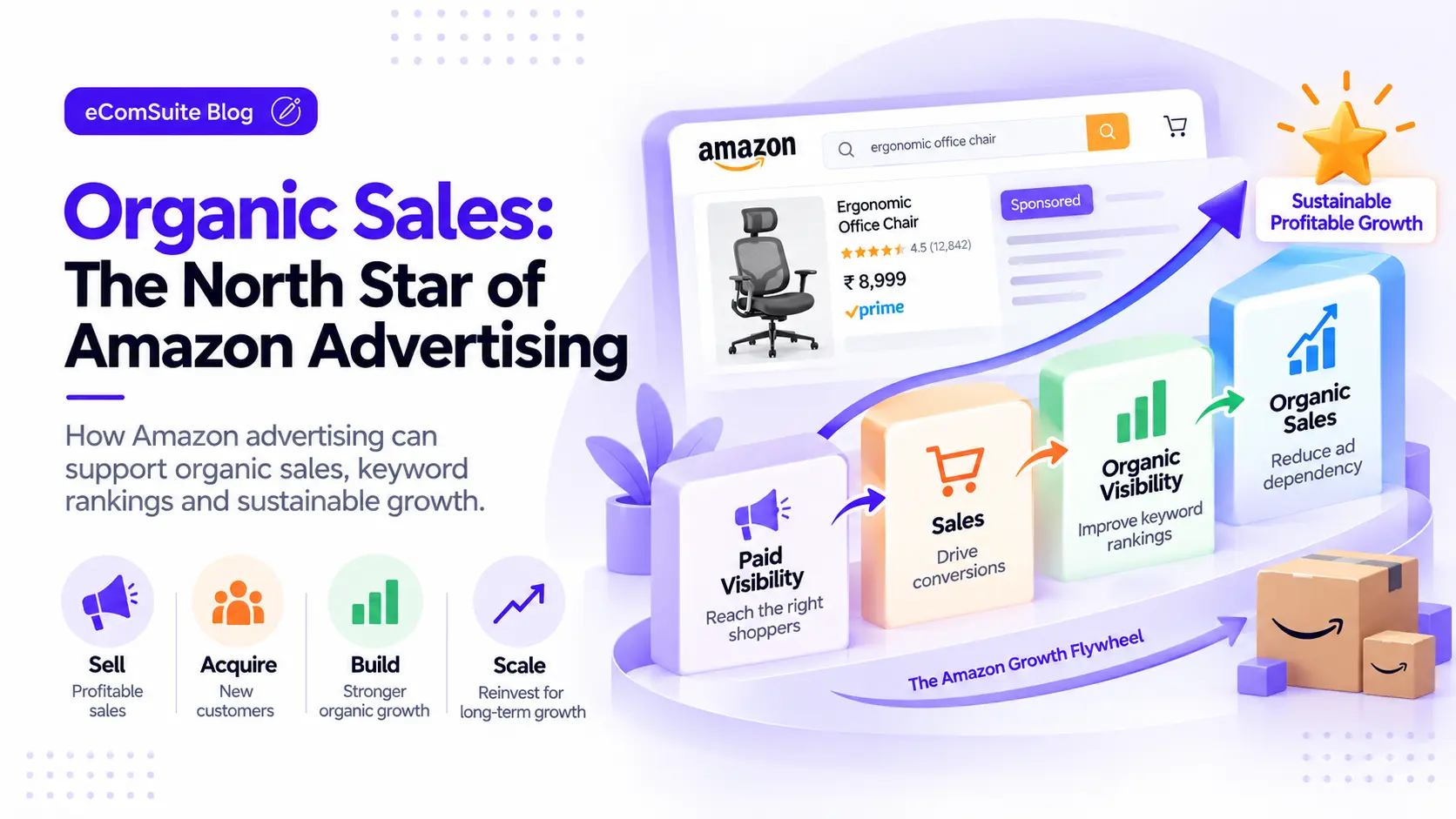
Think Beyond ROAS: Sell, Acquire, Build and Scale
A useful way to evaluate Amazon advertising is through four questions.
Sell: What did my advertising sell?
This is the immediate performance layer.
- Ad sales.
- ROAS.
- ACoS.
- Orders.
- Conversion.
- Profitability.
This tells you what your advertising generated directly and whether those sales make economic sense.
Acquire: What did my advertising acquire?
- Did advertising introduce the product or brand to new shoppers?
- Did it help capture demand outside your branded searches?
- Did it help a newly launched ASIN establish itself?
- Did it expand the pool of customers discovering your products?
This is the acquisition layer.
Build: What did my advertising build?
This is the question that is often missing.
- Did organic sales grow?
- Did important search terms gain organic visibility?
- Did total sales increase without advertising costs increasing at the same rate?
- Did TACoS improve?
- Did the product become stronger beyond paid traffic?
Scale: What can I grow next?
If the product is becoming stronger, where should the next advertising rupee go?
- New keywords?
- New customer acquisition?
- Category expansion?
- Brand building?
- Another ASIN?
- A new product launch?
Strong advertising does not end with efficiency.
It creates opportunities to reinvest into the next stage of growth.
Can Amazon Advertising Help Increase Organic Sales?
Consider a simple example.
You sell an ergonomic office chair.
One strategically important customer search is:
“ergonomic office chair”
Your product currently has weak organic visibility for that search.
You launch a Sponsored Products campaign targeting the keyword.
Advertising gives your product an opportunity to appear in front of shoppers searching for that type of product.
Some shoppers see the ad.
Some click.
Some purchase.
You begin generating sales around an important and highly relevant customer search.
But there is an important distinction.
Amazon does not publicly disclose a simple formula that says:
X PPC conversions = Y positions higher in organic search.
Organic search is more complex than that.
So sellers should not assume they can simply buy organic rank.
Instead, think about advertising as a way to create relevant visibility and generate sales opportunities around demand your product may otherwise struggle to capture.
Then monitor what happens to organic visibility and organic sales over time.
Advertising Can Accelerate a Strong Product
A new ASIN often starts with a difficult problem.
- It has little sales history.
- It may have few reviews.
- It has limited organic visibility.
And because shoppers cannot easily discover it, generating the sales needed to establish the product becomes difficult.
Advertising can help break that cycle.
Instead of waiting for organic discovery:
Paid Visibility → Traffic → Conversion → Sales
But advertising cannot permanently compensate for a weak retail offer.
More traffic will not solve:
- Poor pricing.
- Weak product images.
- Poor reviews.
- Low conversion.
- An irrelevant listing.
- Inventory problems.
- Featured Offer problems.
- Or a product shoppers simply do not want.
Advertising can accelerate a strong retail offer. It cannot manufacture sustainable demand for a weak one.
How the Paid-to-Organic Transition Can Develop
For many successful ASINs, the role of advertising changes as the product matures.
Phase 1: Discovery
The product is new or has weak visibility.
Paid sales may represent a large share of total sales.
The objective may be discovery, traffic, initial conversions and learning which searches actually work.
Phase 2: Build
Patterns begin to emerge.
Certain keywords convert.
Certain customer searches repeatedly generate orders.
The seller can start concentrating investment around the demand that matters.
Phase 3: Strengthen
Organic sales contribution begins to increase.
Some strategically important search terms may gain stronger organic visibility.
Total sales increase.
TACoS may begin improving.
Advertising is still important, but the product is becoming stronger beyond paid traffic.
Phase 4: Scale
Advertising does not disappear.
Its job evolves.
The seller can reinvest into new keyword opportunities, category expansion, new customer acquisition, brand building, additional ASINs and new product launches.
This creates a healthier growth cycle than simply spending more money on the same traffic forever.
High ROAS Does Not Always Mean Incremental Growth
This is where experienced sellers need to look beyond the headline number.
Imagine someone searches directly for your brand.
Your product already has strong organic visibility.
The shopper clicks your Sponsored Product and purchases.
The advertising console attributes the sale to advertising.
The ROAS may look excellent.
But ask another question:
Would some of those shoppers have purchased anyway?
Now consider a non-branded category search where your product has weak organic visibility.
Advertising introduces the product to a shopper who may otherwise never have discovered it.
The ROAS might be lower.
But the strategic value of those two clicks can be very different.
This is the idea of incrementality.
Ad-attributed revenue tells you what sales were attributed to advertising.
It does not necessarily tell you how much additional business would not have happened without advertising.
That is one reason the highest-ROAS campaign is not automatically the campaign creating the most long-term growth.
Branded and Non-Branded Demand Should Not Be Treated the Same
Suppose you sell under the brand ABC Home.
A shopper searches:
“ABC Home office chair”
That shopper already knows your brand.
Now compare that with:
“ergonomic office chair for work from home”
The second shopper is expressing category demand rather than brand demand.
Both searches matter.
But they represent different customer behavior.
Your branded campaign may produce excellent ROAS.
Your category campaign may produce lower ROAS but introduce your product to entirely new shoppers.
That is why advertising decisions should consider:
- Branded demand.
- Category and non-branded demand.
- Product and ASIN targeting.
- New customer acquisition.
Alongside ROAS and ACoS.
Don’t Optimize Away Your Future Growth
Suppose an important non-branded keyword produces:
ROAS: 2.5x
Your normal target is:
ROAS: 3.5x
The obvious optimization decision might be:
Reduce the bid.
Sometimes that is exactly the right decision.
But first ask:
- Is this keyword strategically important?
- Does it represent meaningful category demand?
- Does the product convert for the search?
- Is it helping us reach new shoppers?
- Is total product sales growing?
- Is organic visibility changing?
- Is organic sales contribution increasing?
- Is TACoS improving?
- Can the product economically support this investment?
A lower-ROAS keyword is not automatically a bad keyword.
Sometimes you are paying for inefficient traffic.
Sometimes you are investing in strategically valuable demand.
The job of an experienced advertiser is to know the difference.
But Don’t Use “Organic Growth” to Justify Bad Advertising
The opposite mistake is equally dangerous.
A seller sees poor ROAS and says:
“It’s okay. We are building organic ranking.”
That cannot become an excuse for unlimited spending.
If advertising spend continues increasing while organic sales remain flat, total sales barely move, conversion remains weak, TACoS keeps increasing and the ASIN remains heavily dependent on advertising, you need to challenge the strategy.
There is a major difference between:
Temporarily accepting lower advertising efficiency to build a product
and
Permanently subsidizing a product that cannot establish sustainable demand.
Give Your Keywords Different Jobs
Not every keyword deserves the same advertising strategy.
Instead of looking at hundreds of keywords as one large performance table, sellers can group strategically important keywords by their role.
Defend
Keywords where you already have strong visibility and want to protect important demand.
Build
Commercially important searches where paid advertising converts but organic visibility remains weak.
Scale
Keywords where paid performance, organic visibility and total product sales are moving positively.
Discover
New searches where you are still testing customer demand and conversion.
Now the advertising conversation changes.
Instead of:
“ROAS is below target. Reduce the bid.”
you can ask:
“What is the job of this keyword, and is it achieving that job?”
Measure Organic Growth at the ASIN Level
Account-level organic sales can hide what is really happening.
Suppose account organic sales increased 20%.
That sounds positive.
But perhaps one bestseller grew 80% while five other products became increasingly dependent on advertising.
The account-level number hides that.
For each important ASIN, monitor:
- Ad spend
- Ad-attributed sales
- Organic sales
- Total sales
- ACoS and ROAS
- TACoS
- Organic sales contribution
- Strategically important search-term visibility
- Conversion trends
- Inventory availability
- Featured Offer status
- Contribution margin or profitability
Then look at the trend over weeks and months.
The question is not:
“Did organic sales increase yesterday?”
The better question is:
“As we invest in this ASIN, is the overall business around the product becoming stronger?”
Organic Sales Contribution Can Reveal the Transition
A useful metric is:
Organic Sales Contribution = Organic Sales ÷ Total Sales
Suppose an ASIN develops like this:
| Month 1 | Month 6 | |
| Ad Spend | ₹50,000 | ₹60,000 |
| Ad Sales | ₹1,50,000 | ₹1,80,000 |
| Organic Sales | ₹50,000 | ₹2,20,000 |
| Total Sales | ₹2,00,000 | ₹4,00,000 |
| ROAS | 3.0x | 3.0x |
| TACoS | 25% | 15% |
| Organic Contribution | 25% | 55% |
ROAS stayed exactly the same.
But the business changed dramatically.
- Organic sales increased from ₹50,000 to ₹2,20,000.
- Total sales doubled.
- Organic contribution increased from 25% to 55%.
- TACoS dropped from 25% to 15%.
If your advertising report only shows ROAS, you could miss the most important part of the story.
But there is an important warning.
Do not optimize organic contribution in isolation.
You could increase organic contribution simply by turning advertising off.
If total sales then collapse, you have not created a better business.
Organic contribution becomes meaningful when evaluated alongside total sales, profitability and TACoS.
Don’t Automatically Give Advertising All the Credit
There is another important mistake to avoid.
Suppose organic sales increase 30% after you increase advertising.
Did advertising cause all of that growth?
Not necessarily.
Organic sales can also change because of:
- Seasonality.
- Promotions.
- Price changes.
- Improved reviews.
- Listing changes.
- Inventory availability.
- Category demand.
- Events such as Prime Day or major festive sales.
- Changes in market conditions.
That means sellers should look at trends and context rather than assuming every organic improvement came from PPC.
- Compare performance over meaningful periods.
- Look at what changed.
- Understand which ASINs and search terms moved.
- And avoid confusing correlation with causation.
Advertising may be an important contributor to organic growth without being the only contributor.
Organic Growth Is Not an Advertising-Only Problem
You can target the perfect keyword and still fail.
Why?
Because advertising only gets the shopper to the product.
The retail experience still has to convert.
Listing Quality
Your title, attributes, images and content need to clearly communicate what the product is and why shoppers should buy it.
Price
More traffic cannot permanently overcome an uncompetitive offer.
Reviews and Ratings
Traffic without trust can produce clicks without enough conversions.
Inventory
Advertising, organic growth and inventory planning need to work together.
Accelerating demand without sufficient inventory can create a stockout and interrupt the momentum you are trying to build.
Featured Offer
Changes in Featured Offer status can affect advertising and conversion.
Conversion
Ultimately, shoppers have to choose your product.
This is why Amazon advertising should not operate in isolation from inventory, pricing, listings and overall business performance.
The Amazon Advertising Growth Flywheel
A better way to think about advertising is:
Relevant Paid Visibility
↓
Qualified Traffic
↓
Conversion & Sales
↓
Growing Product Sales History
↓
Monitor Organic Search Visibility
↓
Growing Organic Sales
↓
Improving TACoS and Business Economics
↓
Reinvest Into New Growth Opportunities
And the cycle starts again.
That is very different from:
Spend → Ad Sales → ROAS
What Should You Review Every Week?
Your weekly advertising review should absolutely continue asking:
- What was our spend?
- What was our ROAS?
- What was our ACoS?
- Which campaigns performed well?
- Where are we wasting money?
But don’t stop there.
Ask:
- What happened to total sales?
- What happened to organic sales?
- Which ASINs increased their organic contribution?
- Which strategically important search terms are gaining or losing visibility?
- Where are we still heavily dependent on advertising?
- Are our non-branded campaigns introducing us to new demand?
- Is TACoS moving in the right direction?
- Are we growing profitably?
- Do we have enough inventory to support the demand we are creating?
And perhaps the most important question:
What are we building with the money we are spending?
The North Star
The goal of Amazon advertising is not to eliminate advertising.
Successful brands will continue advertising.
They will advertise to launch products.
- Acquire customers.
- Build awareness.
- Capture category demand.
- Protect important positions.
- Test new opportunities.
- And accelerate profitable growth.
The goal is to make sure advertising creates a stronger business than the one you had before you spent the money.
That means looking at advertising through four lenses:
- Sell: Did advertising generate profitable sales?
- Acquire: Did advertising help us reach new customers or capture new demand?
- Build: Are organic visibility, organic sales and the overall strength of the product improving?
- Scale: What have we learned, and where can we profitably invest next?
- ROAS matters.
- ACoS matters.
- TACoS matters.
- Organic sales matter.
- Profitability matters.
But none of them should become the business objective in isolation.
The ultimate objective is:
Sustainable, profitable total sales growth.
So the next time you review your Amazon advertising performance, don’t only ask:
“What ROAS did my ads generate?”
Ask:
“What did my advertising sell, acquire, build and help me scale?”
Because the strongest Amazon advertising strategy is not simply one that generates the next paid sale efficiently.
It is one that helps make the entire business stronger.
Want to see what your advertising is building?
Sign Up - Free