


- By Admin
-
 Advertising
-
 11 September, 2026
Your Amazon campaign is performing exactly as you hoped.
Traffic is up. Conversion is healthy. Sales are growing. The campaign is consistently delivering the return you want.
So you increase the budget. Then you discover that your product has only a few days of inventory left. The campaign wasn't the problem. The problem was making an advertising decision without looking at inventory.
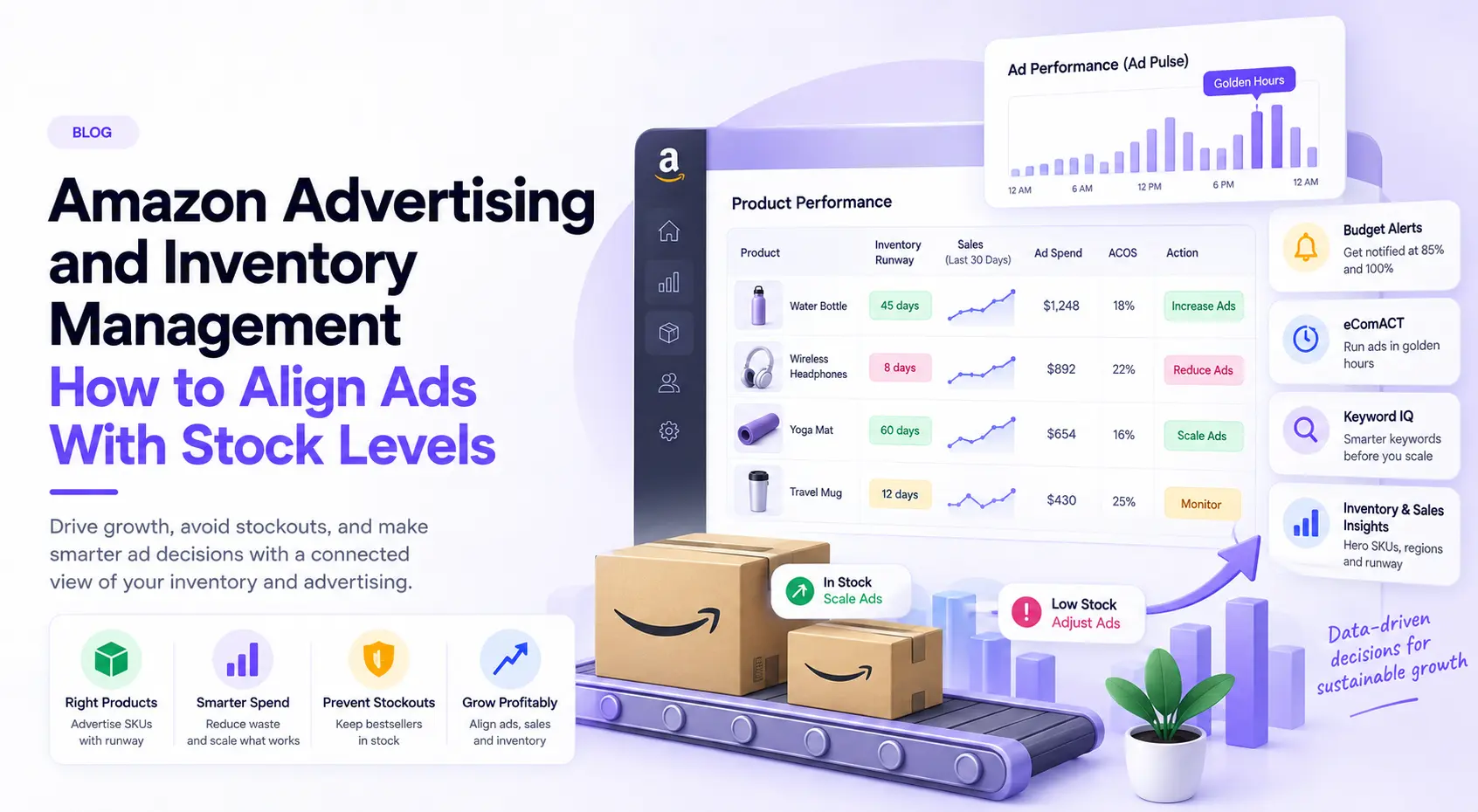
For Amazon sellers, advertising and inventory are closely connected. Advertising creates demand, while inventory determines how much demand the business can actually fulfill.
That leads to an important shift in thinking:
Don't optimize Amazon advertising in isolation. Optimize it for profitable demand that your business is ready to support.
This is the idea behind inventory-aware advertising.
Why Amazon Advertising and Inventory Need to Work Together
Traditional campaign optimization usually starts with advertising metrics: spend, clicks, conversion, ACOS, ROAS, and campaign performance.
Those metrics matter, but they don't tell the complete business story.
Consider two products.
Product A has strong conversion, excellent ROAS, and 45 days of inventory.
Product B has even stronger ROAS-but only eight days of inventory, with replenishment expected in three weeks.
Looking only at advertising performance, Product B looks like the obvious candidate for more budget. Looking at the business as a whole, the answer is less obvious.
You also need to know:
- How quickly is the product selling?
- When will replenishment arrive?
- Is this a Hero SKU?
- Where is demand strongest?
- Can the available inventory support additional demand?
The goal isn't automatically to reduce advertising when inventory is low. It is to make advertising decisions in the context of inventory, demand, and replenishment.
What Is Inventory-Aware Advertising?
Inventory-aware advertising means using inventory and sales signals alongside advertising performance when deciding where and when to spend.
Instead of asking only:
"Which campaign is performing best?"
you also ask:
"Which products have the inventory capacity to support additional demand?"
This creates three common scenarios:
- Healthy inventory + strong demand: An opportunity to increase advertising coverage and budget when campaigns are producing profitable sales.
- Low inventory + strong demand: A reason to be more selective. You may want to protect high-converting traffic while reducing broader discovery activity.
- Excess inventory + weak demand: An opportunity to use advertising to create more qualified demand and improve inventory movement.
So inventory-aware advertising isn't simply about spending less. It is about spending where the business is best positioned to convert and fulfill that demand.
The Five Signals Sellers Should Connect
You don't need a complex forecasting system to start. A practical approach begins with five signals.
1. Inventory Runway
How many days can current inventory support the expected sales rate?
A product with 40 days of inventory presents a very different advertising opportunity from one with seven days.
2. Sales Velocity
Inventory levels become meaningful when viewed alongside sales velocity.
A product selling 100 units a day has a very different runway from one selling 20 units a day with the same inventory on hand. Promotions and advertising can change that velocity quickly.
3. Hero SKUs
Not every SKU deserves the same advertising strategy.
For a Hero SKU with healthy inventory, the objective may be to capture as much qualified demand as possible. For a constrained Hero SKU, the priority may shift toward protecting the most valuable traffic.
4. Regional Demand
A product may have healthy total inventory while demand varies significantly by region. Understanding where sales are strongest can help sellers decide where advertising should be more aggressive.
5. Replenishment Timing
Eight days of inventory is manageable when replenishment arrives in three days. It becomes a serious constraint when replenishment is 25 days away.
The key question is:
Can my inventory support the demand my advertising is trying to create until replenishment arrives?
Before Scaling, Make Sure You're Targeting the Right Demand
Inventory-aware advertising starts before you increase your campaign budget. If you're going to create more demand, make sure you're targeting the right demand first.
Keyword IQ helps sellers do that by using AI to suggest advertising-focused keywords for Sponsored Products campaigns.
The goal is to tighten targeting before scaling-not discover after a week of spending that too much budget went toward weak or irrelevant search terms.
That creates a simple sequence:
Improve targeting → validate performance → scale spend.
Scaling an inefficient campaign simply scales the inefficiency.
Use Hourly Data to Find Your Golden Hours
Daily campaign averages can hide important patterns.
A campaign may have a healthy conversion rate overall while performing very differently throughout the day. For example, conversion may be strong from 9 AM to 12 PM and weak from 12 PM to 3 PM.
eComSuite's Ad Pulse provides a seller-friendly view of Sponsored Products performance using near-real-time hourly insights from AMS.
It helps sellers see:
- Traffic and conversion patterns by hour
- Budget usage throughout the day
- Performing versus bleeding hours
- How quickly campaigns are consuming daily budgets
Instead of simply asking, "Did this campaign perform today?", sellers can ask:
"When did it perform best, and when was I spending without enough return?"
Those hourly insights can become especially valuable during promotions and high-demand shopping events.
Turn Golden Hours Into Campaign Action
Finding your strongest hours is useful. Acting on them is where the opportunity becomes operational.
With eComACT, sellers can turn the patterns identified by Ad Pulse into campaign schedules:
- Identify stronger hours.
- Mark them as golden hours.
- Schedule campaigns around those periods.
- Pause or ease off during consistently weaker periods where appropriate.
This allows sellers to move beyond a one-size-fits-all daily campaign strategy.
For inventory-constrained products, it can also help concentrate spend during periods when advertising is most valuable rather than generating demand indiscriminately throughout the day.
Don't Let Budget Become an Invisible Constraint
Even strong campaigns can lose momentum when daily budgets are consumed too early. A campaign that reaches its budget by midday may miss valuable traffic later in the day. Meanwhile, a weak campaign can continue consuming budget that could be better allocated elsewhere.
eComSuite's Budget Alerts help sellers stay ahead of this.
Sellers receive an email alert when a campaign reaches 85% of its daily budget, followed by another notification at 100%.
At 85%, the question is:
Is this campaign performing well enough to justify additional budget?
At 100%:
Was this the right campaign and the right product to fund today?
During multi-day promotional events, these decisions matter every day-not just on launch night.
Put Advertising and Inventory Decisions Together
The real value comes from connecting these signals instead of managing them separately.
Consider two Hero SKUs:
| Metric | Healthy Hero SKU | Constrained SKU |
| Inventory Runway | 32 days | 10 days |
| Sales Trend | Accelerating | Accelerating rapidly |
| Advertising | Strong conversion | Broad campaigns generating high traffic |
| Budget Pace | Reaches 85% by midday | Consumed early |
| Replenishment | Confirmed & en route | 25 days away |
| Potential Action | Capture more demand during stronger hours | Reduce broad exposure and protect high-value traffic |
Both products may have excellent ROAS. But the right advertising action is different because the inventory context is different. That is the difference between optimizing a campaign and optimizing advertising for the business.
A Simple Framework for Inventory-Aware Advertising
A practical workflow can be built around five questions:
- Inventory: What can I support?
- Demand: How quickly is it selling?
- Targeting: Am I creating the right demand?
- Advertising: When and where is my spend working?
- Action: How should my campaigns respond?
This creates a continuous cycle:
Inventory → Demand → Targeting → Advertising → Action
As inventory, sales velocity, budgets, and replenishment change, the advertising strategy can change with them.
Make Every Advertising Rupee Work With Your Inventory Strategy
Amazon advertising and inventory management are often treated as separate functions. They shouldn't be.
Advertising creates demand. Inventory determines how much demand the business can fulfill. Sales data shows how quickly inventory is moving, while campaign data shows where advertising is producing results.
eComSuite connects those decisions.
- Inventory and Sales Insights helps sellers understand inventory runway, sales movement, Hero SKUs, and regional demand.
- Keyword IQ helps improve Sponsored Products targeting with AI-generated advertising-focused keywords before sellers scale.
- Ad Pulse exposes hourly advertising patterns and highlights performing and bleeding hours.
- Budget Alerts help sellers respond before campaigns consume their entire daily budget.
- eComACT turns strong hourly patterns into campaign schedules.
Together, these capabilities help sellers move beyond:
"Which campaign has the best ROAS?"
to the more important question:
"Which demand should I create, when should I create it, and can my business support it?"
That's the foundation of inventory-aware Amazon advertising. Don't just advertise the products that perform. Advertise the products your business is ready to support.
Book an eComSuite walkthrough to see which products are ready to scale, which campaigns are consuming budget too early, and where inventory constraints may be limiting your growth.
Book a Demo