


- By Admin
-
 Advertising
-
 04 September, 2026
Amazon advertising strategy should change as your product changes.
A new product needs discovery, traffic, and enough early data to understand how shoppers respond. A mature product usually needs a different focus: improving efficiency, protecting profitable search terms, defending the brand, and making sure advertising dollars are concentrated where they have the greatest impact.
That means there is no single Amazon Ads optimization strategy that works for every SKU.
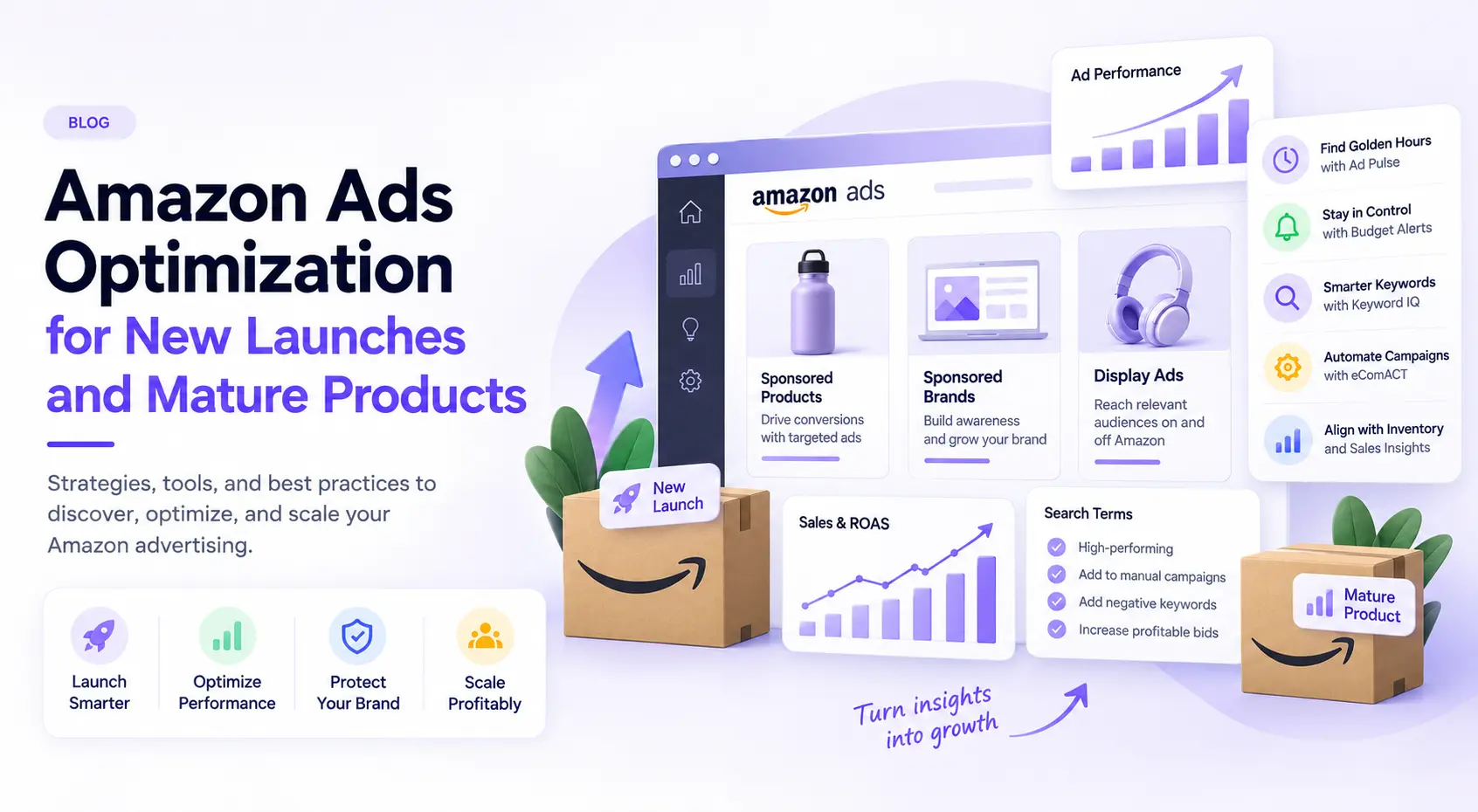
Amazon offers several advertising formats-including Sponsored Products, Sponsored Brands, and Display Ads-and sellers can combine automatic and manual targeting, search-term insights, audience targeting, and budget controls to support different business objectives.
For sellers, the goal is not simply to spend more on advertising. It is to learn faster, target more precisely, and put budget behind the products, shoppers, keywords, and time periods that matter most.
Choosing the Right Amazon Ad Type
Before optimizing campaigns, it helps to understand the role each ad format can play.
Sponsored Products
Sponsored Products are cost-per-click ads that promote individual product listings. Sellers can use automatic targeting, where Amazon determines relevant matches, or manual targeting, where sellers choose keywords or products to target.
For many sellers, Sponsored Products are the starting point for both product launches and ongoing performance optimization.
Sponsored Brands
Sponsored Brands are designed to help shoppers discover and engage with a brand through formats such as video, images, and product collections. Ads can appear in prominent shopping placements and can direct shoppers to product detail pages or a Brand Store.
For a new product, Sponsored Brands can help introduce the product as part of the broader brand. For a mature product, they can help defend branded searches, showcase a wider product portfolio, and encourage shoppers to explore additional products.
Display Ads
Amazon's current Display Ads offering includes the solution formerly known as Sponsored Display. Display advertising can help advertisers reach relevant audiences using contextual and audience-based targeting, including shoppers who have previously interacted with products or brands.
Together, these formats can support a broader strategy across discovery, consideration, conversion, and repeat engagement.
Amazon Ads Strategy for New Product Launches
Launching a new product is different from optimizing an established bestseller. A new ASIN has limited performance history, so the early objective is often to generate relevant exposure and learn which searches, audiences, and placements are most valuable.
Amazon itself offers New Product Campaigns built around a 90-day launch period, with awareness, consideration, and conversion phases.
For sellers managing their own Sponsored Ads, a practical launch strategy can follow a similar progression: discover, learn, refine, and scale.
Start with Discovery Using Automatic Targeting
Automatic targeting can be a useful way to get a new Sponsored Products campaign started because Amazon can match the advertised product to relevant customer searches and products. Amazon identifies four automatic targeting strategies: close match, loose match, substitutes, and complements.
The advantage is not simply reach. Automatic targeting can also generate valuable information about how shoppers are discovering the product.
At the same time, sellers should not rely entirely on automation. Amazon recommends using a mix of automatic and manual targeting.
Build Your Initial Keyword Set Before You Scale
New products do not have to wait for weeks of campaign data before building a keyword strategy.
eComSuite's Keyword IQ uses AI to suggest ad-focused keywords that can help sellers develop an initial keyword set before scaling Sponsored Products campaigns.
This creates a two-source learning model:
- Before launch: use Keyword IQ and your existing product/category knowledge to build an initial keyword list.
- After launch: use automatic targeting and search-term reporting to discover additional queries and refine the list based on actual shopper behavior.
The goal is not to replace Amazon's targeting signals. It is to give your campaigns a stronger starting point and then continuously improve the targeting as real performance data becomes available.
Use Search-Term Data to Move From Discovery to Precision
Once campaigns have generated enough data, review the search-term report to identify which customer searches are generating clicks, conversions, and sales.
Amazon recommends using search-term reporting to understand keyword performance and then leveraging strong-performing terms in manual campaigns.
A simple workflow is:
- Discover: automatic targeting and broader manual targeting.
- Evaluate: review search-term and targeting performance.
- Promote: move promising searches into more focused manual campaigns.
- Refine: adjust bids and use negative targeting where appropriate.
Amazon also provides tools such as Target Promotion to help advertisers identify high-performing targets for further refinement.
Protect the Launch Budget
New campaigns can consume budget quickly, particularly when there is strong shopper demand.
That creates a practical problem: a campaign that exhausts its daily budget early may not be available later when additional shoppers are searching and converting.
eComSuite's Budget Alerts help sellers monitor this risk by sending email notifications when a campaign reaches 85% and again at 100% of its daily budget.
The 85% alert gives sellers a decision point:
- Is this campaign performing well enough to justify more budget?
- Should the budget be increased?
- Or is the campaign spending without delivering enough value?
This becomes especially useful during multi-day promotional periods, such as Prime Day or the Great Freedom Sale, when budget decisions need to be revisited throughout the event rather than only on the first day.
Amazon Ads Optimization for Mature Products
Once a product has accumulated meaningful sales and advertising history, optimization becomes less about discovering whether the product can attract shoppers and more about improving where and how advertising dollars are deployed.
For mature products, the focus typically shifts toward profitable targeting, efficient bids, brand defense, inventory-aware advertising, and better use of historical performance data.
Turn the Search-Term Report Into Better Targets
The search-term report is one of the most useful inputs for mature Sponsored Products campaigns.
Look for searches that consistently generate valuable outcomes and consider moving them into focused manual campaigns. Amazon recommends reviewing target performance and increasing bids on targets that generate sales while removing or adjusting targets that do not meet campaign objectives.
At the same time, identify searches that consume spend without delivering the desired results.
Negative targeting can help reduce unwanted exposure and improve campaign efficiency. Amazon specifically identifies negative targeting as one of the three Sponsored Products targeting options alongside automatic and manual targeting.
This creates a continuous optimization loop:
Search-term data → winning targets → focused campaigns → negative targets → better efficiency.
Use Sponsored Brands to Defend and Expand the Brand
Mature products should not rely exclusively on Sponsored Products.
Sponsored Brands can help protect brand visibility when shoppers are actively searching for the brand, while also creating opportunities to showcase multiple products or send shoppers to a Brand Store. Amazon positions Sponsored Brands across awareness, consideration, customer acquisition, and loyalty objectives.
For example, a mature hero SKU can be used to bring shoppers into the brand ecosystem, while a Sponsored Brands campaign or Brand Store experience introduces complementary or newer products.
This makes Sponsored Brands particularly useful when a seller's objective extends beyond a single product purchase.
Use Display Ads to Reach Relevant Audiences
Display Ads provide another way to reach shoppers beyond keyword-based Sponsored Products campaigns.
Amazon's current Display Ads offering supports contextual and audience-based targeting and can be used alongside Sponsored Products to reach both new shoppers and shoppers who have previously interacted with products or brands.
For mature products, sellers can use Display Ads as part of a broader strategy to re-engage relevant shoppers, expand product consideration, and complement search advertising.
The important point is that Display Ads should have a clearly defined audience and objective rather than simply adding another source of advertising spend.
Find Your Best Hours With Hourly Performance Data
Campaign performance can vary throughout the day.
For a mature product with enough historical data, looking only at daily totals can hide important patterns. Two campaigns might have similar daily conversion rates while behaving very differently from hour to hour.
This is where eComSuite's Ad Pulse can help.
Ad Pulse gives sellers a near-real-time, hourly view of Sponsored Products performance, including:
- Traffic and conversion patterns throughout the day
- Performing hours versus bleeding hours
- How quickly campaigns are consuming daily budgets
The goal is to identify the periods when shoppers are generating stronger outcomes and distinguish them from periods where campaigns may be spending heavily without enough conversion.
Think of these as your golden hours and bleeding hours.
Golden hours are periods when your advertising historically performs well.
Bleeding hours are periods where spend continues but the resulting traffic or conversion does not justify the investment.
Amazon also provides advertisers with hourly reporting and schedule-based budget capabilities, making time-based optimization an increasingly practical part of campaign management.
Turn Performance Insights Into Action With eComACT
Finding your strongest hours is only useful if you act on the insight.
With eComACT, sellers can use their identified golden hours to schedule campaigns around stronger periods and reduce exposure during consistently weaker periods.
A practical workflow is:
- Measure: Use Ad Pulse to understand hourly traffic, conversion, and spend.
- Identify: Mark the periods that consistently perform better.
- Schedule: Use eComACT to prioritize those golden hours.
- Reduce waste: Pause or ease off campaigns during consistently inefficient periods.
This does not mean every low-conversion hour should automatically be shut down. Some campaigns may have awareness or strategic value even when immediate conversion is lower.
The objective is to use historical performance to make budget deployment more deliberate.
Align Advertising With Inventory
Advertising performance cannot be separated from inventory availability.
If a Hero SKU has limited inventory and a long replenishment lead time, aggressive advertising can accelerate sell-through faster than the business can replenish stock.
That is why advertising decisions should be viewed alongside sales and inventory data.
eComSuite's Inventory and Sales Insights tools give sellers visibility into Hero SKUs, regional performance, and inventory runway.
For example, if a key product has only a short inventory runway, a seller may choose to reduce broad discovery spending and prioritize the highest-performing campaigns.
On the other hand, excess inventory can create a different opportunity. Sellers may choose to increase advertising activity where additional demand can help move inventory efficiently.
The broader principle is simple:
Advertising should support the inventory strategy-not work against it.
A Practical Amazon Ads Optimization Framework
Whether you are launching a new product or managing an established bestseller, the optimization process can follow a simple cycle:
Discover → Learn → Refine → Scale → Defend → Automate
- Discover: Use automatic targeting, initial keywords, and broader campaign strategies to find relevant shoppers.
- Learn: Analyze search-term, targeting, hourly, sales, and inventory data.
- Refine: Move strong targets into focused campaigns, adjust bids, and add negative targeting where appropriate.
- Scale: Put additional budget behind campaigns and products that are delivering the desired outcomes.
- Defend: Use Sponsored Brands and Display Ads to strengthen brand visibility and maintain customer consideration.
- Automate: Use tools such as eComSuite's Ad Pulse, Budget Alerts, Keyword IQ, eComACT, and Inventory and Sales Insights to reduce manual monitoring and act on performance signals faster.
The strategy changes as the product matures, but the underlying principle stays the same: use data to decide where your next advertising dollar should go.
Conclusion
Amazon Ads optimization is not about finding one perfect campaign structure and leaving it untouched.
A new product needs discovery and learning. As the product gains traction, the emphasis should shift toward better targeting, stronger bids, more disciplined budgets, brand defense, audience expansion, and inventory-aware decisions.
Sponsored Products can provide the foundation for keyword and product-level advertising. Sponsored Brands can strengthen brand discovery and portfolio visibility. Display Ads can complement search campaigns by reaching relevant audiences beyond keyword targeting.
The challenge for sellers is turning all of that data into decisions quickly enough to matter.
That is where technology can help.
Keyword IQ helps sellers develop a stronger keyword starting point. Ad Pulse surfaces hourly performance patterns. Budget Alerts help sellers act before strong campaigns lose the rest of their daily budget. eComACT turns hourly insights into campaign schedules. And Inventory and Sales Insights helps sellers make advertising decisions with a clearer view of product performance and inventory runway.
The result is a more disciplined approach to Amazon advertising:
Discover faster, target smarter, spend deliberately, and scale what works.
Empower your growth with eComSuite's multi-channel marketing tools.
Get Started
Sign Up - Free