


- By Admin
-
 Advertising
-
 21 August, 2026
You launch a new campaign on Monday.
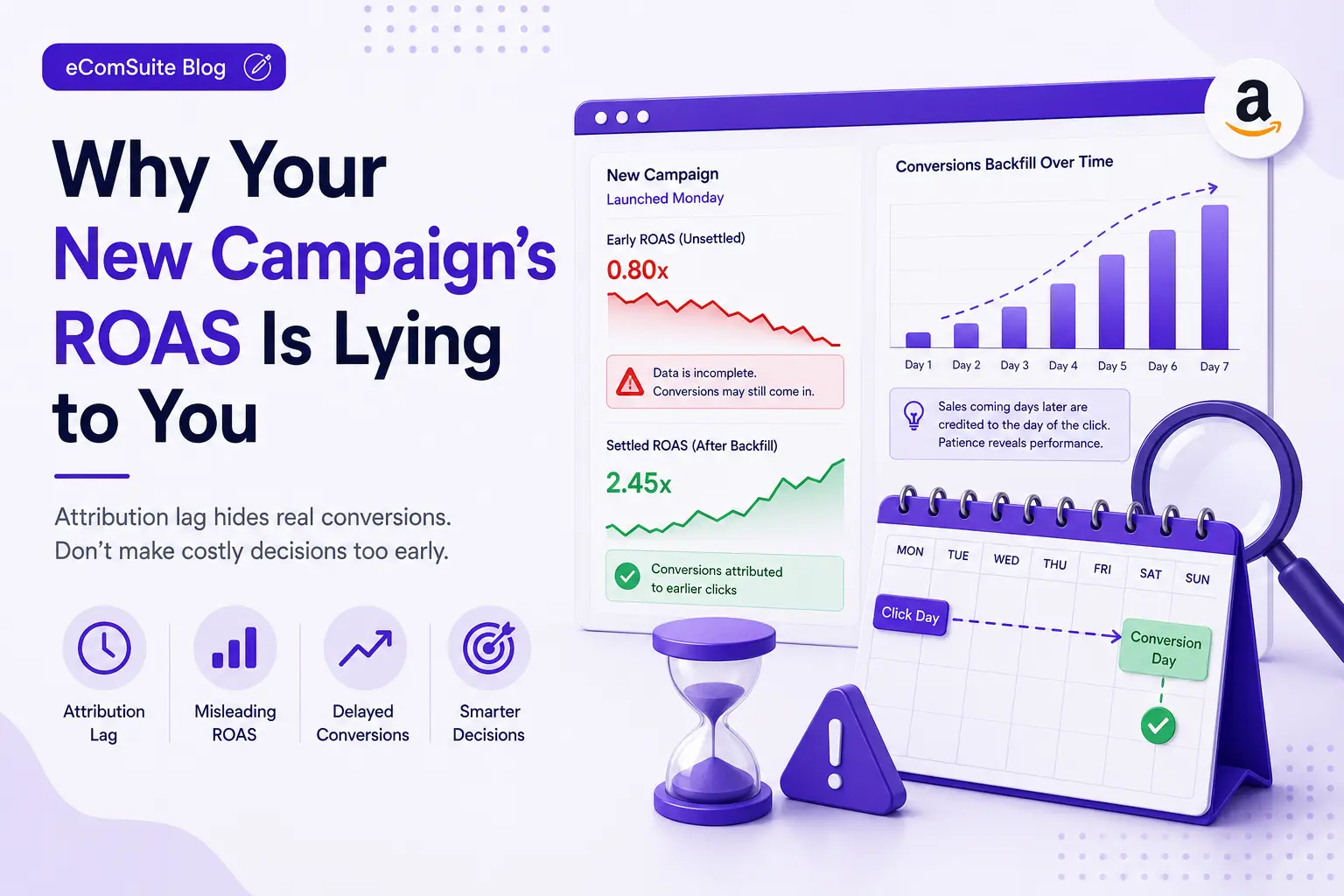
By Wednesday, you check it. ROAS is 0.8x. By Friday it has barely moved. The spend is real, the sales aren't there, and you've seen enough - you pause it.
That's a reasonable decision. The data was clear, and you acted on it quickly, which is what good advertisers do.
Weeks later, you notice something odd in the report. That campaign has conversions attributed to clicks from Tuesday and Wednesday - sales that arrived after you paused it, credited back to the days when the dashboard was telling you nothing was working.
The decision wasn't wrong. The evidence was incomplete, and nothing in the interface said so.
What Attribution Lag Actually Is
When a shopper clicks on your ad, they don't always buy immediately. They compare, they leave, they come back, and they buy days later.
Amazon handles this by attributing that eventual sale back to the click that started it, within a lookback window. The exact window depends on the ad type, but the principle is the same across all of them: the sale is credited to the day of the click, not the day of the purchase.
That's the correct way to measure advertising. It's also the source of the problem.
It means a click on Monday can generate a sale on Saturday, and that revenue gets written back into Monday's row - five days after you read Monday's row and drew a conclusion from it.
Every recent day in your report is therefore understated. Not slightly, and not randomly. Systematically, with the newest days understated the most.
Your ROAS number isn't wrong. It's unfinished.
Why It's So Hard to Spot
If the dashboard flagged it, this would be a non-issue. It doesn't.
A three-day-old ROAS of 0.8x and a ninety-day-old ROAS of 0.8x render identically. Same font, same colour, same decimal places. One is a settled figure you can act on. The other is a partial figure that will rise. Nothing in the interface distinguishes them.
The effect is worst exactly where it hurts most. A mature campaign is barely affected - it has been accumulating backfill every single day for months, so the amount arriving today roughly matches the amount that arrived yesterday. The distortion cancels out.
A new campaign has no accumulated backfill at all. Its early days are pure understatement. And new campaigns are precisely the ones you watch most closely, judge most quickly, and feel most anxious about, because you don't yet know whether they'll work.
The campaigns most distorted by attribution lag are the campaigns most likely to be killed early.
The Part That Compounds
This isn't just noise in the data. It's a bias with direction, and biases with direction accumulate.
You evaluate early. Campaigns that look bad get paused. Campaigns that look good get more budget. Over months, your surviving portfolio is selected on partial evidence - and specifically, it over-selects for products with short purchase-consideration cycles, because those are the ones whose conversions arrive fast enough to show up before you make the call.
Slower-converting products, higher-priced items, considered purchases, anything a shopper thinks about for a few days - all of them look structurally worse in every early evaluation you run. Not because they perform worse. Because they report slower.
And the feedback loop never corrects, because a paused campaign stops generating clicks. It never gets the chance to backfill and prove you wrong. You don't see the correction, so nothing tells you the rule you're applying is miscalibrated.
How to Tell If Your Data Has Settled
There's no indicator for this, so it has to be a habit rather than a feature you switch on.
- Check the age of the data before you read the number. This is the whole discipline in one sentence. A metric's meaning depends on how much time has passed since the clicks that produced it. Ask "how old is this?" before "what is this?"
- Never compare windows of different ages. A campaign's first week measured against another campaign's third month is a comparison between an unsettled number and a settled one. If you need an early read, compare like for like: this campaign's first week against other campaigns' first weeks. Both are understated by roughly the same amount, so the comparison still carries signal.
- Use the metrics that settle fast. Click-through rate, cost per click, impressions and top-of-search impression share are all click-side - they are complete almost immediately. They won't tell you whether a campaign is profitable, but they will tell you whether it's broken. A campaign with no impressions has a targeting or bid problem you can diagnose today. A campaign with impressions, clicks and no conversions yet may just be early. If you want to read those click-side signals at a finer resolution, hourly reporting through Amazon Marketing Stream makes the difference between "not working" and "not yet" much easier to see.
- Prefer rolling averages to single days. A seven-day rolling ACoS is far more stable than any individual recent day, because the older days inside the window have largely settled and dampen the newest day's understatement.
- Watch absolutes, not just ratios. Ratios like ROAS and ACoS have the incomplete number in the denominator, which is what makes them volatile early. "Significant spend with zero orders" is a blunter signal, but a more reliable one - zero is zero regardless of what's still in flight.
What to Do in the Three Situations Where This Bites
Scenario 1: A New Campaign Is Showing Poor Early ROAS
- Separate structural problems from performance problems. Structural issues are visible immediately and don't need mature data: irrelevant search terms, wrong match types, a listing that isn't converting the traffic it's already getting, or bids too low to win any impressions.
- Fix: Audit the structure now and defer the profitability verdict until the attribution window has substantially closed. If the structure is sound and clicks are arriving, poor early ROAS is the expected reading, not a result.
Scenario 2: You're Comparing a New Campaign Against an Established One
- This comparison is invalid by construction. You're measuring a partial number against a complete one and treating the gap as a performance difference.
- Fix: Compare same-age windows, or use a rolling average that gives the newer campaign's earlier days time to settle. If you must rank campaigns of mixed ages, rank on click-side metrics - CTR, CPC, impression share - which don't have this problem.
Scenario 3: You Changed Something and Want to Know If It Worked
- You raise a bid, adjust a budget or add keywords, then check performance a few hours later. The post-change data has had almost no time to attribute, so the change will nearly always look worse than it is.
- Fix: Set a minimum observation period before re-evaluating, and don't stack a second change on top of an unsettled first one. Sequential adjustments made faster than the data can settle produce oscillation - you end up reacting to lag, not to performance. This is one of the places where automation and human control have to be sequenced deliberately rather than fired off in parallel.
The Uncomfortable Part
The honest fix here is patience, and patience isn't free.
A campaign that is genuinely bad burns budget every day you extend the benefit of the doubt. "Wait for the data to settle" is easy advice to give and expensive advice to follow, and anyone telling you it's costless hasn't paid for it.
So the real skill isn't waiting. It's knowing which decisions can wait and which can't.
- Structural decisions shouldn't wait. If a search term is irrelevant to your product, that's true on day one and will still be true on day thirty. Negate it now. The same logic applies to keyword conflicts between your own campaigns, which are visible the moment they exist.
- Performance decisions should wait. Whether a campaign is profitable is a question about conversion data, and conversion data has a settling time you can't shorten by looking at it more often.
Most bad early decisions come from applying performance logic to a question that was actually structural, or the reverse. Sorting the two is worth more than any threshold you could set.
The Broader Lesson
Attribution lag is one instance of a much more general problem: every metric has a settling time, and almost no dashboard shows it.
Amazon fees post with a delay, which means recent-period profitability reads better than it will finally be. Settlements include orders from prior months, so a month's payout isn't a clean measure of that month's sales. Return rates on recent cohorts look artificially low, because the returns haven't happened yet.
In every case, the number on the screen is accurate and incomplete at the same time, and the interface gives you no way to tell which you're looking at.
The habit that protects you is the same one every time. Before you ask what a number says, ask how old it is and whether it's finished.
How eComSuite Handles This
A few things in the platform are built around this problem.
- Keyword IQ's recommended actions include Test and Monitor alongside Add, Optimize, Reduce and Pause. A keyword with moderate opportunity is flagged for testing over a few days rather than getting an immediate verdict, and where no other condition is met, the recommendation is to monitor with no action needed.
- Pause is recommended on high spend with zero orders rather than on poor ROAS - an absolute condition rather than a ratio.
- Target Keyword Performance shows a 7-day rolling average ACoS alongside daily ACoS for each keyword, so you can read the stable figure and the volatile one side by side.
- Ad Pulse tracks campaign budget usage in near real time, alerting you when a campaign has hit 85% of its budget and when it's fully exhausted. Budget exhaustion is a click-side condition - it's true the moment it happens and doesn't depend on any conversion data settling, so it's worth acting on immediately.
Wait for the data where the data needs waiting for. Act immediately where it doesn't.
Want to see which of your keywords are ready for a decision and which need more evidence? eComSuite's Keyword IQ scores every keyword with a confidence level and a recommended action.
Get Started
Sign Up - Free