


- By Admin
-
 AI & Automation
-
 24 July, 2026
Selling on Amazon has never been more challenging or more rewarding.
Every day, new products enter the marketplace, customer buying patterns evolve, advertising costs fluctuate, and Amazon continues to refine its algorithms. Success is no longer determined by who works the hardest. It's determined by who can make the fastest, smartest, and most informed business decisions.
The challenge isn't a lack of data. In fact, Amazon provides sellers with more reports than ever before, covering sales, advertising, inventory, search terms, customer behavior, and business performance.
The real challenge is turning that overwhelming amount of information into meaningful action.
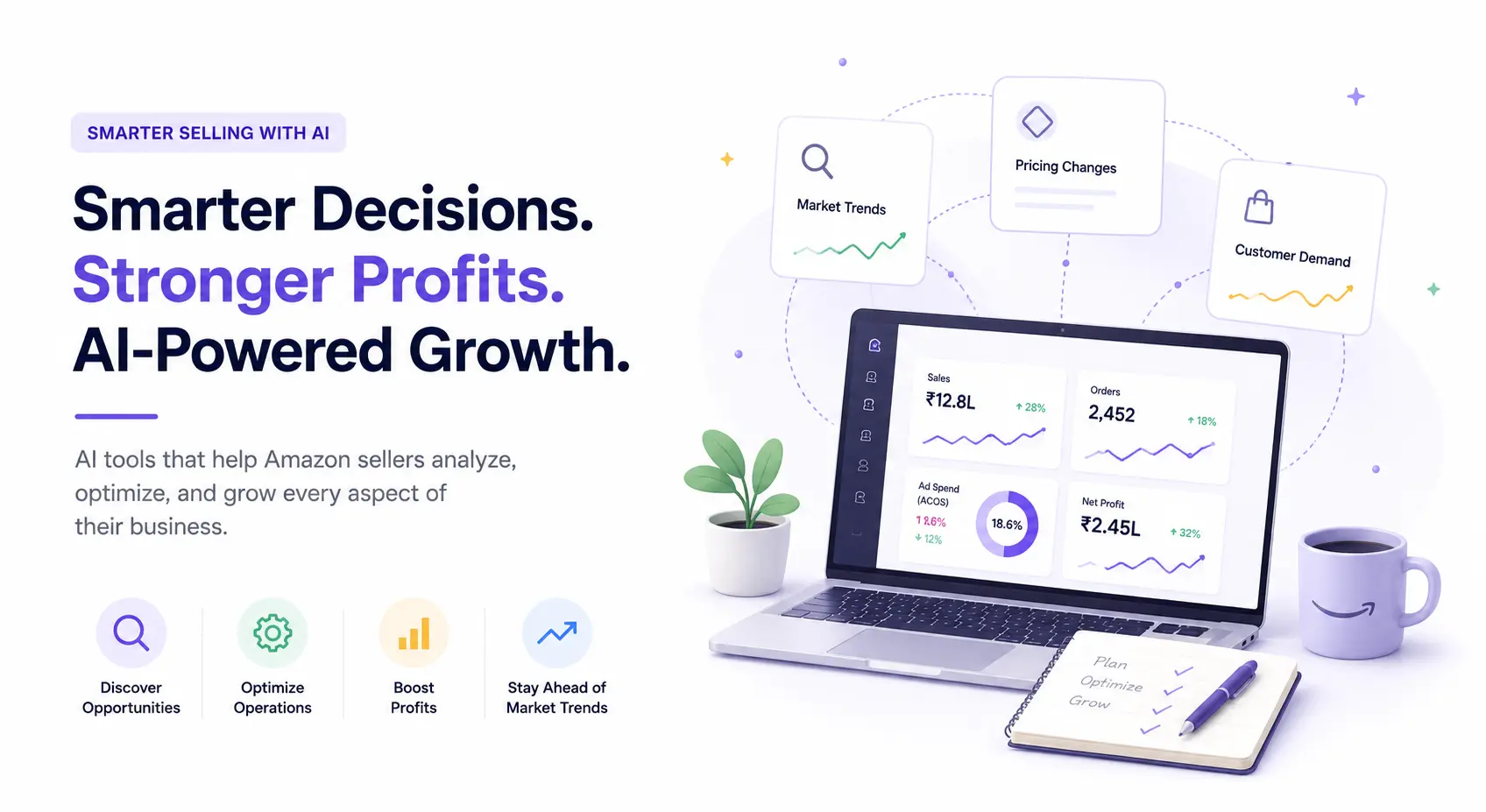
This is why AI-powered Amazon seller tools are rapidly becoming an essential part of every successful seller's business.
Instead of spending hours analyzing spreadsheets, downloading reports, and trying to identify trends manually, AI continuously monitors your business, uncovers opportunities, highlights risks, and recommends the next best actions.
The question is no longer:
"Do I need an Amazon seller tool?"
The better question is:
"Can my business continue growing efficiently without AI?"
The New Reality of Selling on Amazon
Running a successful Amazon business today involves much more than simply listing products. Every seller needs to manage:
- Product research
- Keyword performance
- PPC campaigns
- Inventory forecasting
- Pricing strategy
- Profitability
- Returns and reimbursements
- Customer buying trends
- Market changes
- Sales analytics
Every one of these activities generates valuable data. But data alone doesn't help businesses grow.
What matters is understanding:
- What changed?
- Why did it happen?
- What should I do next?
Finding those answers manually takes time. AI delivers them in seconds.
Instead of acting as another reporting tool, AI acts like a virtual business analyst working around the clock to identify opportunities, detect risks, and recommend actions that help businesses make smarter decisions every day.
Why Amazon Sellers Are Rapidly Adopting AI
The biggest transformation in eCommerce isn't simply automation. It's intelligent decision-making.
Traditional seller software provides dashboards. AI-powered seller software provides direction.
Instead of asking sellers to interpret hundreds of charts and reports, AI answers questions like:
- Why did sales decline yesterday?
- Which campaigns are wasting advertising budget?
- Which products are becoming less profitable?
- Which keywords should receive more investment?
- Which ASINs require immediate attention?
- Which products should be replenished first?
- What market trends should I pay attention to?
Rather than spending hours searching for answers, sellers receive actionable insights within minutes. That allows businesses to spend less time analyzing data and more time making decisions that drive growth.
1. AI Saves Hours Every Week
Many Amazon sellers spend hours every week downloading reports, updating spreadsheets, calculating profitability, reviewing campaigns, and tracking inventory. These repetitive tasks consume valuable business time.
AI automates data collection, analysis, and reporting, presenting important insights through simple dashboards and intelligent recommendations. The result is:
- More time to focus on business growth
- Less manual work
- Fewer reporting errors
- Faster decision-making
For growing businesses, AI doesn't just save hours - it creates capacity to scale without increasing operational complexity.
2. AI Detects Problems Before They Become Expensive
One of AI's greatest strengths is continuous monitoring.
Rather than waiting until weekly reports reveal a problem, AI identifies unusual business patterns as they happen. For example, AI can detect:
- Sudden drops in sales
- Rising advertising costs
- Falling ROAS
- Increasing ACOS
- Declining keyword rankings
- Unexpected reductions in profitability
- Low inventory levels
- Changes in customer buying behavior
Early visibility allows sellers to take corrective action before these issues affect revenue and profitability.
3. AI Helps Optimize Advertising Spend
Amazon PPC has become one of the largest investments for most sellers. Managing campaigns manually becomes increasingly difficult as businesses grow.
Without clear insights, sellers often:
- Overspend on underperforming keywords
- Miss high-converting search terms
- Continue running inefficient campaigns
- Allocate budgets without maximizing returns
AI continuously analyzes campaign performance, identifies wasted spend, recommends bid adjustments, uncovers keyword opportunities, and highlights campaigns requiring immediate attention.
Instead of reacting after advertising budgets have been spent, businesses can optimize campaigns proactively. The result is healthier ACOS, stronger ROAS, and better long-term profitability.
4. AI Shows Your True Profitability
Revenue is only one part of the business story. True profitability depends on understanding every cost associated with selling. These include:
- Amazon fees
- FBA charges
- Advertising expenses
- Storage fees
- Returns and refunds
- Reimbursements
- Logistics costs
AI consolidates all these data points to provide a complete view of product-level profitability.
Instead of simply asking,
"How much did we sell?"
successful businesses ask,
"How much profit did we actually make?"
That insight helps sellers improve pricing, advertising, and inventory decisions.
5. AI Predicts Inventory Before Problems Occur
Inventory planning has always been one of the biggest challenges for Amazon sellers. Running out of stock can reduce rankings and impact sales momentum. Overstocking increases storage costs and locks up valuable working capital.
AI analyzes historical sales, seasonality, advertising performance, and demand trends to forecast future inventory requirements.
This enables businesses to replenish inventory at the right time while improving cash flow and reducing unnecessary storage costs.
6. AI Helps You Stay Ahead of Market Changes
The Amazon marketplace changes every single day. Customer demand shifts. Prices fluctuate. Search trends evolve. New products enter the market. Shopping behavior changes during festivals, seasonal events, and promotional campaigns.
Keeping track of these changes manually is almost impossible.
AI continuously analyzes marketplace trends, pricing movements, customer demand, keyword opportunities, and category performance to identify meaningful changes before they significantly impact the business.
Instead of reacting after the market has already changed, sellers can make informed decisions early - whether it's adjusting pricing, optimizing advertising, replenishing inventory, or expanding into growing product categories.
Businesses that understand market trends early are better positioned to make confident decisions.
7. AI Turns Data into Business Decisions
Amazon generates enormous amounts of business data every day.
The challenge isn't collecting information. The challenge is understanding what it means.
AI transforms complex reports into simple business recommendations by answering questions like:
- Which products deserve more advertising?
- Which ASINs need immediate attention?
- Which keywords are driving profitable growth?
- Which products are becoming less profitable?
- Where should the next investment go?
- Which market trends present new opportunities?
Instead of interpreting reports, sellers can focus on making better decisions.
8. AI Makes Business Growth Simpler
Managing 20 products manually is challenging. Managing hundreds or thousands of products manually quickly becomes unsustainable.
As product catalogues expand, advertising campaigns grow, and inventory becomes more complex, manual processes create bottlenecks.
AI scales alongside the business. Whether managing 50 SKUs or 5,000, AI continuously analyzes operations and surfaces the highest-priority insights. This allows businesses to grow without proportionally increasing workload.
What Happens When Businesses Continue Relying on Manual Analysis?
Many sellers still depend heavily on spreadsheets and manual reporting. While these methods may work initially, they become increasingly difficult as businesses grow. Common challenges include:
- Slow decision-making
- Missed growth opportunities
- Higher advertising costs
- Inventory stockouts and excess inventory
- Hidden profitability issues
- Hours spent analyzing reports
- Delayed responses to changing market conditions
Meanwhile, businesses using AI identify market changes earlier, respond more quickly to customer demand, improve advertising efficiency, and make better-informed business decisions.
The difference isn't created overnight. It grows a little every single day.
By the time manual analysis reveals a significant shift in the marketplace, valuable opportunities may already have passed.
Choosing the Right AI-Powered Amazon Seller Tool
Not every seller tool is designed for today's rapidly changing marketplace.
The best AI-powered platforms should provide:
- AI-generated business insights
- Advertising intelligence
- Product profitability analytics
- Inventory forecasting
- Market trend analysis
- Keyword intelligence
- Executive dashboards
- Automated alerts
- Actionable recommendations
- Easy-to-understand reporting
- Reliable customer support
The goal isn't simply to provide more data. It's to help businesses make smarter decisions with less effort.
The Future of Amazon Selling Is AI
Amazon isn't becoming simpler. It's becoming more data-driven.
Every day, thousands of business decisions are influenced by customer demand, advertising performance, pricing movements, inventory levels, and changing market trends.
Businesses that can understand these signals quickly are better positioned to make timely decisions, capture new opportunities, and grow sustainably. Sellers relying solely on manual analysis risk making important decisions after the opportunity has already passed.
AI is no longer just another software category.
It's becoming an essential business partner that helps sellers understand market trends, uncover growth opportunities, optimize operations, and make confident decisions every day.
Platforms like eComSuite represent this new generation of AI-powered Amazon seller software bringing together advertising intelligence, profitability analytics, inventory forecasting, market trend analysis, and actionable recommendations in one unified platform.
Instead of spending hours understanding what happened yesterday, businesses can focus on deciding what to do next.
The future of Amazon selling belongs to businesses that can transform data into decisions - faster, smarter, and with greater confidence.
The sooner sellers embrace AI, the sooner they position themselves for sustainable growth in an increasingly data-driven marketplace.
Ready to Replace Guesswork with AI-Powered Insights?
Get Started
Sign Up - Free